Project Statement: Family Album
There’s a long history regarding the nature of portraiture in photography with an equally long list of attendant questions. What does a photographic portrait capture? An outer likeness in a moment in time, an inner look into the psyche of a subject? Is a photograph objective, descriptive truth emanating outwards from the image or is it an expression of what a photographer subjectively sees in the sitter? Is the portrait a surface document, or a window into the soul?
Intrigued by the objective-subjective possibilities of photography, I set out to experiment with portraits of my own family to see what I’d find. I quickly lost interest in making standard two-dimensional likenesses in which I tried to imbue or discover meaning.
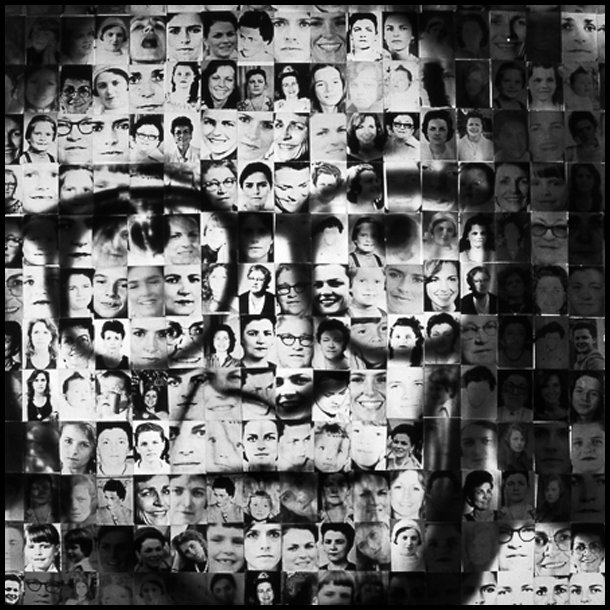
Instead, I veered towards creating collages to comment on the connections between my family members. I sought to create relational portraits that collectively described a clan and would provide insight and understanding as to what binds its members together into a family unit.
My desire to explore these physiognomic and psychological connectors naturally led me to integrating multiple faces which added a third dimension to the portraits. Initially, the photographs remained mostly flat against the wall to be viewed in a traditional manner, which is to say, from a passive frontal perspective.
Gradually, however, the portraits began pulling away from the wall as floating photo “tiles” overlapped features from different faces, or as photo-clad molds offered geometric facets on which separate faces coalesced. The viewer was now required to move in order to see the interconnected portraits in each piece. The way the features connected became metaphor for the nature of the relationships described.
Eventually, the portraits became fully independent three-dimensional heads rotating on hidden spindles. As the heads spun, the expressions changed. The pieces were hung together in a dark room at the respective heights of each member of my family. Using my clan as a proxy, viewers could turn the faces to find the desired expressions for their own family conversation.
This series started as an exploration of portraiture and the truths that could be revealed through photography. As the images became increasingly dimensional and less dependent on the wall or on an exclusively frontal view, the breadth of the portrait also expanded to describe not just an individual but the relationships that tether it to a tribe.
[Return to the Gallery]